How Stories Build Empathy: The Science Behind Raising Kind Kids

Empathy Is Learned, Not Inherited
There's a common misconception that empathy is something you're born with - that some kids are naturally empathetic and others just aren't. The research tells a very different story. While the capacity for empathy is innate (humans are wired for social connection), the skill of empathy - the ability to recognize, understand, and respond to other people's emotions - is learned. It develops through practice, modeling, and experience. And the experiences that build empathy most effectively are, according to a growing body of research, stories.
Harvard's Making Caring Common project, one of the most comprehensive research initiatives on raising ethical, empathetic children, has consistently identified story-based learning as a cornerstone of empathy development. Their research shows that children who regularly engage with narratives - particularly narratives that present diverse perspectives and emotional challenges - demonstrate measurably higher empathy scores than children who don't. Not slightly higher. Significantly higher.
What Happens in the Brain When We Hear a Story
Neuroscience has given us a remarkable window into why stories are so effective at building empathy. When we listen to a story, our brains don't just process language. They simulate the experience being described. If a character climbs a mountain, our motor cortex activates. If a character smells flowers, our sensory cortex fires. And crucially, if a character feels sad, scared, or joyful, our emotional centers respond as if we ourselves were feeling those emotions.
This phenomenon, sometimes called neural coupling or narrative transportation, means that stories are essentially empathy simulators. Every time a child hears a story, they're practicing the act of feeling what someone else feels. They're exercising the same neural pathways they'll use when they encounter real people with real emotions in real situations. The story is a rehearsal space for the empathic responses they'll need throughout their lives.
A 2018 study from the University of Toronto's Department of Applied Psychology and Human Development found that children who were read fiction regularly showed measurably higher performance on theory of mind tasks - the ability to understand that other people have thoughts, beliefs, and feelings that differ from their own. This is the cognitive foundation of empathy, and it was strengthened simply through exposure to narrative fiction. Not special training. Not therapy. Just stories.

When children hear stories, their brains don't passively absorb words. They actively simulate the character's experience - firing emotional, sensory, and motor regions as though the child is living the story themselves. This neural simulation is the biological mechanism behind empathy building through narrative.
The Three Types of Empathy (and How Stories Build All Three)
Psychologists generally identify three distinct types of empathy: cognitive empathy (understanding what someone else is thinking), emotional empathy (feeling what someone else is feeling), and compassionate empathy (being moved to take action to help someone). Most interventions target one of these. Stories, remarkably, build all three simultaneously.
Cognitive empathy develops as children follow the thoughts and motivations of characters whose perspectives differ from their own. Why did the character make that choice? What were they thinking? What didn't they know that the reader knows? These are theory of mind exercises embedded naturally in the narrative. Emotional empathy develops through the neural coupling we discussed - feeling the character's emotions alongside them. And compassionate empathy develops when stories present situations where a character needs help and the protagonist chooses to act. The child, identifying with the protagonist, rehearses the impulse to help.
Why Personalized Stories Amplify the Effect
Here's where the research gets really interesting for what we do at Fable. The empathy-building effect of stories is directly correlated with how deeply the reader identifies with the protagonist. The more a child sees themselves in the main character, the more intensely they simulate the character's experiences, and the more effectively the empathy-building mechanisms work.
Personalized stories - stories where the child's name, appearance, and real-life context are woven into the narrative - create the strongest possible identification with the protagonist. When your child sees a character who looks like them, has their name, and faces situations similar to their own, the psychological distance between reader and character essentially collapses. They're not watching someone else navigate an empathy challenge. They're navigating it themselves.
This means that when a personalized story presents a character encountering someone who's different, lonely, scared, or in need of help, the child processes that experience at a much deeper level than they would with a generic character. The empathy lesson isn't something they observe - it's something they live through. And that lived-through quality is what makes the lesson stick.
Practical Ways to Use Stories for Empathy Building
The research suggests several approaches that maximize the empathy-building potential of storytelling. First, choose stories that present diverse perspectives - characters from different backgrounds, with different abilities, facing different challenges. Exposure to diverse perspectives is one of the strongest predictors of empathic development. Second, pause during stories to ask perspective-taking questions: "How do you think that character is feeling right now?" "Why do you think they did that?" "What would you do if you were in that situation?" These questions activate cognitive empathy and deepen the child's engagement with the character's emotional world.
Third, create stories that directly address empathic challenges your child is facing. If your child is struggling to understand why a classmate acts a certain way, create a story that explores a similar situation from multiple angles. With Fable, you might prompt something like: "A story about [child's name] who discovers that the kid who always seems angry at school is actually dealing with something difficult at home, and learns that people's behavior doesn't always show what they're feeling inside." These targeted stories turn abstract empathy concepts into concrete, personal experiences.
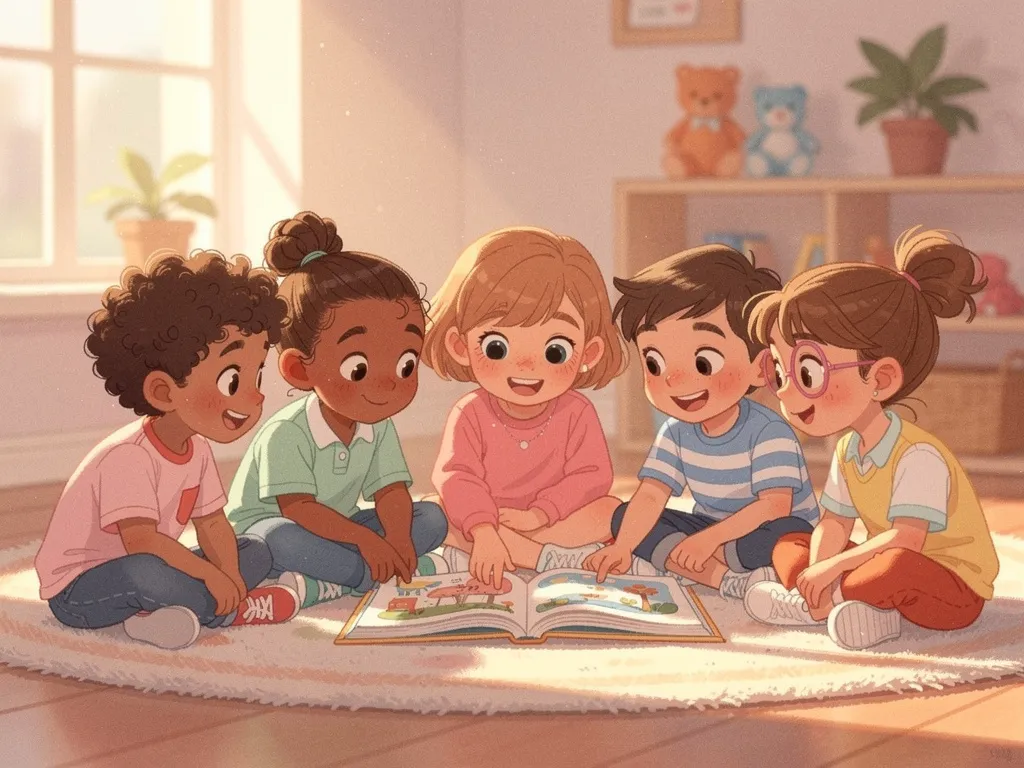
Research from both Harvard and the University of Toronto emphasizes that stories featuring diverse perspectives and characters are particularly powerful for empathy development. When children regularly experience narratives from viewpoints different from their own, they build the cognitive flexibility that underlies real-world empathic responses.
The Harvard Making Caring Common Findings
Harvard's Making Caring Common project, led by psychologist Richard Weissbourd, has spent years studying how children develop empathy and what parents can do to support that development. Their findings consistently point to narrative as a primary mechanism. Specifically, they recommend that parents make story time a regular practice, use stories as jumping-off points for conversations about feelings and perspectives, and actively seek out stories that present characters dealing with moral dilemmas.
One of their most striking findings is that empathy is not a fixed trait but a skill that strengthens or atrophies based on practice. Children who regularly engage in perspective-taking activities - and stories are the most natural, enjoyable form of perspective-taking - develop stronger empathic capacity over time. Conversely, children who rarely encounter diverse perspectives or emotional narratives can struggle with empathy even if they showed early empathic potential. The implication is clear: consistent exposure to diverse, emotionally rich stories is one of the most impactful things a parent can do for their child's empathic development.
Building an Empathy Library
One approach that aligns well with the research is building what I think of as an "empathy library" - a collection of stories that cover a range of emotional and social scenarios. With Fable, you can create stories that address specific empathic challenges: understanding disability, navigating cultural differences, dealing with loss, supporting a friend through a hard time, standing up for someone being treated unfairly. Each story becomes a reference point you can return to when similar situations arise in your child's real life.
The beauty of personalized storytelling is that you can create exactly the stories your child needs, when they need them. Traditional books are wonderful, but they're static. They can't address the specific social dynamics in your child's classroom or the particular emotional challenge they're working through this week. AI-powered personalized storytelling lets you create stories that are precisely tuned to your child's empathic growth edges. That specificity is what the research suggests makes the difference between stories that are entertaining and stories that are genuinely transformative.
Start tonight. Create a story that puts your child in someone else's shoes. Ask them how the characters felt. Watch them make connections between the story and their real life. That's empathy in action - and every story builds the muscle a little stronger.
Frequently Asked Questions
How do stories build empathy in children?
Stories let children step into someone else's shoes safely. When a child reads about a character feeling scared, left out, or excited, their brain activates similar emotional patterns. Over time, this builds the neural pathways for real-world empathy and emotional intelligence.
Does personalization make stories more effective for building empathy?
Yes. When the child is the character showing empathy in the story, it reinforces their identity as someone who is kind and considerate. It shifts from "that character was nice" to "I was nice in that story" - which is a much more powerful message.
What are the best stories for raising kind kids?
Stories where the main character helps someone different from themselves, resolves a conflict peacefully, or understands another character's feelings. Personalized stories are especially effective because the child practices empathy as the hero, not as a passive observer.
I regularly share updates on what I'm building and how I'm improving Fable.
Follow me on XReady to Create Your Own Story?
Create a story in your browser, or download Fable for iOS and Android. Add your own characters, illustrations, and narration.