How to Create Custom Printed Children's Books with AI

Why I Built Printed Books Into an AI Storytelling App
When I started building Fable, the whole idea was AI-generated stories where your kid is the main character. Consistent illustrations on every page. Narration with background music. Videos. The full digital experience. And people loved it. But then something kept happening that I did not expect.
Parents kept asking if they could print the stories. Not as a nice-to-have. As a genuine request. "My daughter wants to take her story to show-and-tell." "Can I make this into a book for my son's birthday?" "My mom lives overseas and does not use apps - can I send her a physical copy?" The same request, over and over, from completely different types of families.
And it made sense when I thought about it. A digital story lives on a screen. It competes with YouTube, games, and a hundred other things fighting for attention. But a printed book? That lives on the bookshelf. It gets pulled out at bedtime. It gets packed in the overnight bag for grandma's house. It gets dog-eared and worn out from being read twenty times. A kid who sees their own face on the cover of a real book - that is a different kind of magic than swiping through a screen.
So I built it. Not as an afterthought or a gimmick, but as a proper print-on-demand pipeline that produces professionally bound, full-color children's picture books. The same quality you would find in a bookstore, except the main character is your child and the story is one they helped create.
The Problem with Most "Personalized" Books
Before I explain how Fable's printed books work, it is worth talking about what already exists in this space - because most of it is not great. The typical personalized children's book is a template. You type in a name, maybe pick a hair color, and you get a pre-written story with your kid's name dropped in. "One day, [Child Name] went on an adventure." The illustrations are generic. Every kid gets the same pictures. The story is the same for everyone. It is personalization in the loosest possible sense.
Fable is fundamentally different because the stories themselves are generated by AI based on your specific input. You choose who the characters are - your child, their siblings, their friends, even their pet. You pick the art style - watercolor, anime, claymation, comic, photo-realistic, and over a dozen others. You guide the story with prompts, and the AI creates something that has never existed before. And critically, the character illustrations stay consistent across every single page. Your kid does not look like a different person on page 3 than they do on page 12. That consistency is what makes the printed book feel real.
How It Works: Stories First, Then Books
The workflow is straightforward. Everything starts with stories. You open Fable, create a story by describing what you want - the characters, the setting, the kind of adventure - and the AI generates the full narrative with illustrations. Each story produces roughly 24 to 32 pages of content: illustrated scenes paired with text, plus title pages and transitions. You can read it in the app, listen to the narrated version with music, or generate a video from it. But when you are ready to make a book, that is where things get interesting.
You select which stories you want to include. You need a minimum of 2 stories to create a book - this ensures there are enough pages for a properly bound volume. You can include up to 20 stories in a single book, which means you could create anything from a slim bedtime reader to a comprehensive anthology of your kid's greatest adventures. Each story becomes its own chapter.
Stories, videos, and books are completely independent features in Fable. You always start by creating your stories - those are the foundation. But once your stories exist, you can turn them into a video, a printed book, or both. Some families create a story, watch the video together, and then order the printed book as a keepsake. Others skip the video entirely and go straight to print. It is entirely up to you.
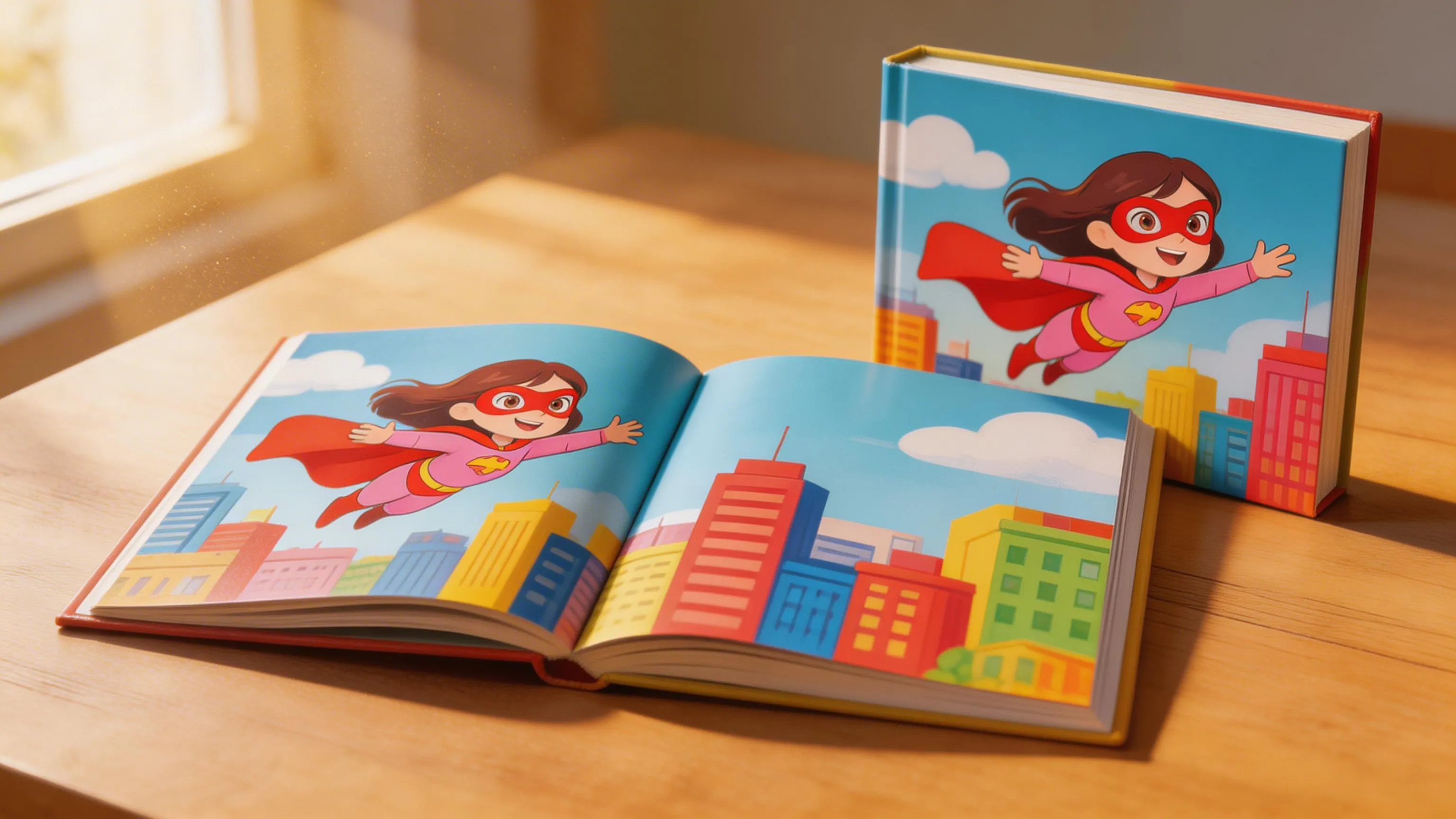
Every story you create in Fable becomes a chapter in your child's very own book. The illustrations stay consistent across every page - your kid looks the same on page 1 as they do on page 50. That consistency is what separates these from generic "personalized" books where every illustration looks like a different child.
Choosing Your Art Style
One of the things that makes Fable books feel special is the range of art styles available. When you create a story, you choose the visual style, and that style carries through to the printed book. Want a classic storybook feel? There is a style for that. Prefer bold anime-inspired illustrations? You can do that. Watercolor, claymation, comic book, pixel art, photo-realistic - there are over 16 styles to choose from.
This means every family's book looks different. Not just because the characters are different, but because the entire visual identity is different. A book of fairy tales might use the watercolor style. A superhero adventure might use comic book style. A book about a kid exploring space might use photo-realistic illustrations. The style you pick becomes part of the book's personality, and it makes each one feel like a unique piece of art rather than a mass-produced product.
AI-Generated Covers That Match Your Stories
The cover matters. It is the first thing people see, and for a kid, it is the thing that makes them grab the book off the shelf. Fable does not just slap a generic design on the front. When you are ready to create your book, you provide a guided prompt - maybe "my daughter as a space explorer standing on the moon" or "the whole family as superheroes in front of the city" - and the AI generates 4 unique cover options. Each one features the book title and the characters from your selected stories, in the art style you chose.
Not happy with any of the four? Generate new ones. There is no limit. Keep regenerating until you find the cover that makes your kid's eyes light up. And because we know AI can occasionally produce something that is not quite right - a hand that looks weird, a background element that is off - you can edit the images to tweak anything that needs fixing. The goal is a cover that looks like it was commissioned from a professional illustrator.
Book Specs: Sizes, Formats, and Finishes
Every Fable book is currently printed at 8.5 x 11 inches (21.6 x 27.9 cm). That is a large-format children's picture book - the same size as many of the classic picture books you probably grew up with. The pages are printed on 80-pound coated white paper, which gives the illustrations rich, vibrant color and a premium feel when you turn the pages.
You have full control over the format. For binding, you choose between hardcover and paperback. Hardcovers are more durable, feel more like a gift, and hold up better to the kind of enthusiastic page-turning that young readers are known for. Paperbacks are lighter, more affordable, and great if you want to order multiple copies. For color, you choose between full-color and black and white printing. Most families go with color for the vivid illustrations, but black and white has its own charm and keeps costs down. For finish, you pick matte or glossy. Matte has a soft, modern feel. Glossy is vibrant and eye-catching, and it is better at resisting little fingerprints.
You can order as many copies as you need in a single order. One for home, one for grandma, a few for birthday party favors, extras for the classroom. And we are flexible on book sizes going forward - the current 8.5 x 11 inch format works great for picture books, but we are actively listening to what our customers want. If there is demand for smaller formats, board books, or other dimensions, we are open to it.

Printed on 80-pound coated white paper with vivid full-color illustrations. Whether you choose hardcover or paperback, matte or glossy - the result is a book that looks and feels like something you would find in a bookstore. Except the hero on every page is your kid.
Pricing, Discounts, and How Payment Works
Here is how the economics work, because I know this is the first thing most people want to know. Fable uses a token system for creating content - making stories, generating videos, and creating book covers all use tokens. But the actual book purchase - the printing and shipping of the physical book - is paid in regular currency through a standard Stripe checkout. You are not spending tokens to buy the book itself. Tokens create the content. Money buys the physical product.
Book pricing is calculated based on three things: the page count of your book, whether you choose color or black and white printing, and whether you go with hardcover or paperback binding. You see the exact price during the checkout flow before you commit to anything. There are no hidden fees or surprise charges.
If you are a Fable Premium subscriber, you get 30% off every book order. That discount adds up quickly if you are creating books regularly - seasonal collections, birthday books for different kids, gift copies for family members. It is one of the most tangible perks of the Premium tier because you are saving real money on physical products.
Preview Everything Before You Order
This is one of the features I am most proud of, because it solves a real anxiety that people have about ordering printed products online: "What if it does not look right?" Before you go to checkout, Fable generates a full preview PDF of your entire book. Every page. Every illustration. The cover. The layout. You can flip through the whole thing and see exactly what will arrive at your door.
And if something is not right - maybe an illustration has an AI artifact, or a background element looks off - you can edit individual images before they go to print. We know AI-generated content is not always perfect on the first try. Rather than forcing you to accept imperfections or start over from scratch, we built editing tools so you can tweak the details. The combination of preview and editing means you should never be surprised by what arrives in the mail.
International Shipping and Delivery Options
Fable ships books internationally, and we have customers ordering from the US, Europe, Asia, and beyond. Shipping costs depend on your location, but most destinations offer multiple shipping tiers. Ground shipping is the most affordable and works great if you are planning ahead. Priority shipping gets the book there faster for time-sensitive occasions like birthdays, holidays, or that show-and-tell deadline your kid mentioned at breakfast.
The printing and fulfillment infrastructure is built to handle a wide range of destinations, so wherever you are, chances are we can get a book to your door. Shipping options and costs are shown during checkout so you can choose what works best for your budget and timeline.
What Makes This Different from Print-on-Demand Templates
There are other services that let you create "custom" children's books, and some of them produce nice-looking products. But almost all of them work from templates. You are filling in blanks in a pre-existing story. The illustrations were drawn once by a human artist, and your kid's name gets digitally inserted. It is a form letter dressed up as a storybook.
Fable generates the entire story from scratch. The narrative, the illustrations, the character designs, the cover - all of it is created by AI based on your specific inputs. No two books are the same, because no two stories are the same. Your child's book is genuinely one-of-a-kind. And because Fable maintains consistent character appearances across all illustrations, the book has visual coherence that you would expect from a professionally illustrated publication.
The other difference is the creative control. In a template-based service, you pick from their stories and their art. In Fable, you guide the story with your own prompts. You pick from over 16 art styles. You choose which characters appear and what they look like. You can include your child's real appearance using reference photos, so the character in the book actually looks like them. The result is not just a personalized book - it is a book that could not have been made by anyone else, because it reflects your family's specific imagination.
Gift Ideas and Use Cases
The most common use case is exactly what you would expect: parents making books for their own kids. Bedtime story collections. Adventure anthologies. A book for each birthday that captures what the kid was into that year - dinosaurs at age 4, space at age 5, underwater exploration at age 6. But we see a lot of other use cases too.
Grandparents order books starring their grandchildren as holiday gifts. Teachers create stories featuring their students for end-of-year presents. Parents make books as gifts for other kids' birthday parties - which, honestly, is a much better party favor than another bag of candy. Families dealing with difficult transitions - a new sibling, moving to a new city, starting school - create stories that help kids process those changes through narrative. And some parents simply want a keepsake that captures this specific moment in their child's life, in a format that will still be on the shelf in twenty years.

From a single bedtime story to a whole collection of adventures - your child's stories become real books they can hold, share, and read again and again. Stack them on the bookshelf right next to the classics. They belong there.
A Feature That Is Still Growing
I want to be upfront about something: printed books are a relatively new feature in Fable, and we are still actively improving it based on real customer feedback. Every order teaches us something. Every suggestion from a parent or grandparent or teacher helps us make the next version better. We are iterating on the image editing tools, exploring additional book sizes, refining the cover generation, and working on making the whole flow even smoother.
If you have ideas about what would make Fable books better for your family - different sizes, different paper options, different binding styles, anything at all - we genuinely want to hear about it. This feature exists because customers asked for it in the first place. The best version of it will be shaped by the people who actually use it.
In the meantime, if your kid has stories in Fable that they love, consider turning them into something they can hold. There is a moment - when a child sees their own face on the cover of a real book for the first time - that is worth the entire exercise. I have seen it happen. It never gets old.
Frequently Asked Questions
How many pages are in a Fable printed book?
Each story generates roughly 24 to 32 pages of illustrated content. Since you need a minimum of 2 stories per book and can include up to 20, your book can range from about 50 pages to over 400 pages depending on how many stories you include.
What size are Fable printed books?
Books are currently printed at 8.5 x 11 inches (21.6 x 27.9 cm), which is a standard large children's picture book format. We are open to supporting additional sizes based on customer demand.
Can I choose between hardcover and paperback?
Yes. You can choose hardcover or paperback, and within each option you can select matte or glossy finish. You can also choose between full-color and black and white printing.
How much does a printed Fable book cost?
Pricing depends on page count, color vs black and white printing, and hardcover vs paperback binding. Premium subscribers get 30% off all book orders. You can see the exact price before ordering through the preview and checkout flow.
Do I need tokens to order a printed book?
Creating stories and generating covers uses Fable tokens, but the actual book order - printing and shipping - is paid in regular currency through a standard checkout. No tokens are needed for the final purchase.
Can I preview my book before ordering?
Yes. Fable generates a full preview PDF showing every page of your book, including the cover, before you go to checkout. You can also edit individual images if anything needs tweaking.
Does Fable ship books internationally?
Yes. Fable ships to a wide range of countries worldwide. Shipping costs and delivery options (ground, priority, etc.) depend on your location.
Can I customize the book cover?
Absolutely. You provide a guided prompt and Fable generates 4 unique AI cover options featuring your book title and characters from your stories. You can regenerate covers as many times as you want until you find the perfect one.
What art styles are available for printed books?
All 16+ art styles in Fable are available for printed books, including watercolor, anime, claymation, comic book, photo-realistic, storybook, pixel art, and more. The style you choose when creating your story carries through to the printed pages.
Can I include multiple stories in one book?
Yes. You need a minimum of 2 stories and can include up to 20 stories per book. Each story becomes its own chapter, so you can create everything from a slim bedtime reader to a comprehensive adventure anthology.
I regularly share updates on what I'm building and how I'm improving Fable.
Follow me on XReady to Create Your Own Story?
Create a story in your browser, or download Fable for iOS and Android. Add your own characters, illustrations, and narration.
You Might Also Like
From Screen to Bookshelf: How to Print Your Fable Story
February 4, 2026
The Gift with Their Name on Every Page: A Book Gift Guide
December 24, 2025
How to Create a Personalized Children's Book in 5 Minutes
July 23, 2025
The Best Mother's Day and Father's Day Gift: A Book They Star In
May 6, 2025
Create a Custom Storybook as the Perfect Birthday Gift
August 27, 2025